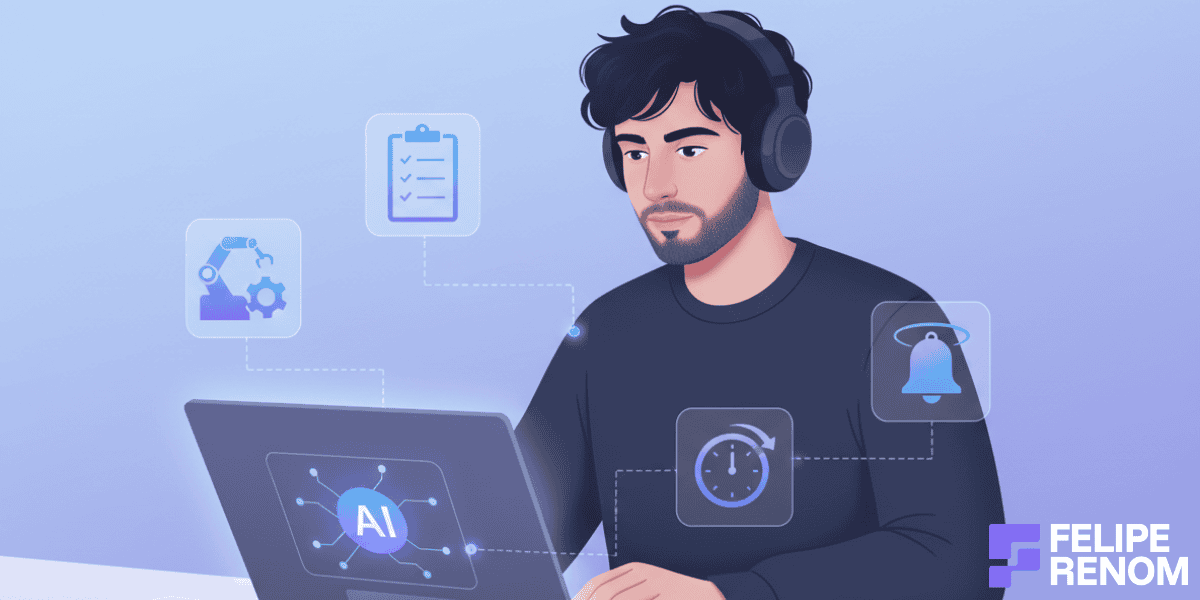
how to use AI for productivity

How to Use AI for Productivity (Full Beginner Guide)

Ever feel like you’re making too many tasks and not making headway? You’re not alone. In a world where time is money, AI is emerging as a productivity powerhouse. Did you know companies leveraging artificial intelligence are seeing up to a 40% boost in efficiency?

Imagine AI tools seamlessly handling your emails, scheduling your meetings with AI-powered scheduling apps, and even streamlining remote teamwork through AI-driven communication, all while you focus on what truly matters.

I remember when I first tried ChatGPT back in 2022. Overwhelmed by endless deadlines and emails, I discovered AI wasn’t just about robots or complex algorithms. It was about smart automation and personalized productivity that redefined my workday. Suddenly, task automation and AI-enhanced productivity apps were not just “one more thing”, but game-changers in my workflow.

man with computer avoiding distractions

So, why does this matter to you? As AI continues to evolve, learning how to use AI for productivity could be the key to unlocking new levels of productivity optimization. From AI in business processes to robotics process automation, the possibilities are vast.

In this blog post, we will go deep into how you can use AI’s potential. Whether you’re an entrepreneur or part of a large corporation, understanding AI’s impact on workplace transformations can set you on the path to success.

Understanding the Basics of AI for Productivity

A few years back, I found myself drowning in emails, deadlines, and endless to-do lists. Sound familiar? That’s when I discovered the world of artificial intelligence.

At first, it seemed like something out of a sci-fi movie. But as I got deeper, I realized AI was not just about robots and futuristic tech. It was a tool that could transform how we work and boost our productivity in ways I hadn’t imagined.

The Role of AI in Modern Workplaces

AI is everywhere these days. From AI-powered scheduling tools that help manage our calendars, to email management solutions sorting our inboxes, AI’s reach is vast.

A buddy of mine in a tech startup swears by AI-driven communication tools for managing remote teamwork. It’s not just about doing things faster; it’s about doing them smarter.

Take task automation, for instance.

Everyday tasks like data entry or sorting through emails?

AI handles those, leaving us time to focus on more strategic work. This is particularly true in project management platforms where AI helps in data integration, offering actionable insights that you wouldn’t spot on your own.

I remember being amazed by how predictive analysis could forecast project timelines and highlight potential roadblocks before they even became an issue.

The Importance of AI Literacy for Employees

Understanding AI isn’t just for IT folks.

It’s crucial for everyone in the workplace.

I once thought AI literacy involved complex algorithms and coding. But it’s really about knowing how AI tools work and how they can be integrated into our daily tasks.

I recall attending an AI training program at our office. At first, it felt like going back to school, but it was worth it.

We learned about machine learning, natural language processing, and how these technologies drive efficiency boost and workflow optimization.

Knowing how to leverage AI for time management and productivity optimization can be what differentiates you from your coworkers.

man signaling "AI"

With AI technology trends constantly evolving, continuous learning becomes essential.

Companies are investing in AI adoption, and employees who understand AI’s potential are more valuable.

So, if you want to keep up with workplace transformations and the future of work, learning how to use AI is a smart move. Plus, it’s kinda fun to impress your coworkers with your newfound skills in AI-enabled innovation!

AI Tools Enhancing Individual Productivity

I remember when I first started exploring AI tools for my work.

Honestly, it was like opening a treasure chest of productivity hacks. As someone who’s always working on multiple tasks, discovering AI’s potential was a life changing.

It felt like having a virtual assistant that never slept. Let me walk you through some of the ways AI tools have boosted my productivity and how they might do the same for you.

Task Automation Tools for a Smoother Workflow

When it comes to task automation, AI tools are like those magical elves from fairy tales, silently getting things done.

One tool that changed the game for me is Zapier. It’s a platform that connects different apps, automating repetitive tasks without my constant input.

For instance, I used to spend hours manually updating spreadsheets and sending follow-up emails. With Zapier, I set up workflows that automatically update my CRM when a new lead comes in or sends a personalized email to follow up.

man surrounded by different ai tools

The time saved was uncalculable.

Another lifesaver is Trello with its AI-powered Butler feature.

It helps automate board actions based on triggers, like moving a card when a deadline is near. These task automation tools allow me to focus on strategic planning and creative thinking, rather than mundane chores.

It’s not just about saving time; it’s about USING time wisely. The efficiency boost is real, and the less time spent on repetitive tasks, the more room there is for innovation.

AI-Powered Scheduling and Email Management for Time Management

Scheduling used to be my nemesis.

Coordinating meetings, finding mutual availability, and dealing with time zone chaos was a nightmare.

Enter AI-powered scheduling apps like Calendly. This app automatically syncs with my calendar and allows clients or colleagues to book meetings during my available slots (in fact, you can go ahead and use it in my homepage).

man looking at the user in a desk with a computer

It’s like having a personal secretary who knows my schedule better than I do. The seamless integration with email makes it a must-have for anyone serious about productivity.

Speaking of emails, let’s not forget about SaneBox.

This AI-driven email management solution sorts my inbox like magic. Important emails land in the main folder, while newsletters and less critical ones are filtered into a separate folder.

I can’t express how much lighter I feel without the constant email barrage. Plus, it learns from my habits, continuously improving its sorting capabilities.

These AI tools not only streamline my day but also transform my approach to time management.

The peace of mind knowing that my schedule and emails are under control is priceless.

It allows me to focus on projects that require my full attention, maximizing my productivity. So, if you’re feeling overwhelmed by your calendar or inbox, consider giving these AI solutions a try. They might just be the productivity boost you need.

AI in Team Collaboration and Communication

I remember the chaos of coordinating with my team across different time zones.

It was like trying to solve a Rubik’s Cube blindfolded.

But then, artificial intelligence came into the picture, and the way we collaborate and communicate shifted dramatically.

AI tools have helped remote teams, turning what was once a logistical nightmare into a streamlined process.

AI Tools Facilitating Remote Teamwork

Working remotely, it can be tough to keep everyone on the same page. But AI’s got our backs.

I first realized this when we started using Slack with its AI-powered features. It’s not just about chatting; it’s like having a smart assistant that organizes conversations and even suggests relevant channels.

The AI algorithms prioritize messages, ensuring I never miss critical updates.

We also love using tools like Zoom for video calls.

The AI-driven transcription feature is a lifesaver. Imagine joining a meeting late and having the transcript ready to catch up—no frantic note-taking required.

Task automation has become our secret weapon. Tools like Asana leverage AI to automate task assignments based on team members’ availability and workload, optimizing our workflow.

These AI collaboration tools not only boost efficiency but also make remote teamwork less stressful.

It feels like the AI is a silent team member, working tirelessly to keep us connected and on track.

AI’s Role in Project Management Platforms

Project management can be a beast, but AI is here to tame it. In my previous role, working on multiple projects felt like spinning plates.

Enter Monday.com, a project management platform infused with AI. It uses data analysis and predictive analysis to offer actionable insights that guide our decision-making.

The AI-enhanced productivity apps assist in identifying bottlenecks before they escalate into major issues.

There’s something magical about how AI handles data integration. It pulls information from various sources, giving us a cohesive picture of our projects.

The time management and workflow optimization it provides are priceless. I remember the first time the AI suggested reallocating resources based on project demands, it was like having a seasoned project manager whispering in my ear.

man in a screen using touchpads

These platforms transform project management by providing a level of business intelligence that feels almost magic, predicting challenges and recommending solutions before they even happen.

AI adoption in project management platforms is a game-changer for businesses of all sizes. It allows us to spend less time buried in spreadsheets and more time driving innovation.

Whether you’re managing a small team or a large enterprise, AI’s integration can lead to significant workplace transformations. It’s not just about keeping the wheels turning; it’s about driving forward with confidence, knowing AI’s got our back.

AI for Data Analysis and Decision Making

Back in my early days of working with a bunch of data, I felt like I was drowning in a sea of numbers.

I’d spend hours manually crunching datasets, only to realize I had missed crucial insights. That’s when I discovered the magic of artificial intelligence in data analysis.

AI tools, like a trusty sidekick, have revolutionized the way we handle and interpret large datasets, providing clarity where there was once chaos.

AI’s Efficiency in Analyzing Large Datasets

There was a time when analyzing large datasets was similar to scaling Everest for me.

Imagine a lot of spreadsheets, each teeming with rows upon rows of data, and me, frantically searching for patterns or trends. It was exhausting and often felt like searching for a needle in a haystack.

Enter AI algorithms.

These algorithms can process vast amounts of data at high speed. I remember the first time I used a cloud-based AI solution to analyze customer feedback for a project.

The AI not only highlighted trends I had overlooked but did so in a fraction of the time it would have taken me. It was like having a digital detective on the case, always a step ahead.

The efficiency boost was undeniable. AI-powered tools looks through data with precision, picking up anomalies and correlations that can guide business intelligence decisions.

Predictive Analysis: Shaping Strategic Planning

Predictive analysis, another cool feature of the AI toolkit, it has reshaped how I approach strategic planning.

I recall a project where we had to forecast sales trends for the next quarter. Historically, this was a shot in the dark, relying on past data and a bit of gut instinct.

But with AI-driven analytics, the process transformed.

The system used machine learning and natural language processing to predict future trends based on historical data. It was like having a crystal ball, but one that relied on data-driven insights rather than magic. The predictions were accurate, allowing us to adjust our strategy proactively.

This AI-enabled innovation allowed us to allocate resources more effectively and identify potential market shifts before they hit. The impact on our strategic planning was profound, resulting in a significant increase in sales and market share.

Predictive analysis isn’t just a tool, it’s a strategic partner that turns data into actionable insights, guiding decision-making with a level of accuracy that was once unimaginable.

AI adoption in data analysis and strategic planning is no longer optional; it’s essential for businesses aiming to stay competitive.

The digital transformation it brings to decision-making processes is nothing short of revolutionary.

Overcoming Challenges in Implementing AI for Productivity

I remember when our office decided to take the AI plunge. It felt like we were on the brink of a digital transformation, yet the path was anything but smooth.

Implementing AI tools for productivity seemed like a no-brainer, but we quickly discovered that the journey was fraught with roadblocks and unexpected hurdles.

Let me share some of the common barriers we faced and how we managed to overcome them.

One of the biggest challenges we encountered was the initial resistance from the team.

AI adoption often feels intimidating, especially when it threatens to change the way you’ve been working for years.

The fear of job displacement and the complexity of AI technology trends can make employees wary. I recall our first meeting where AI was introduced, it was met with skepticism and a lot of crossed arms.

To ease this transition, we focused on AI literacy.

We initiated AI training programs that demystified artificial intelligence, addressing fears head-on.

The sessions were interactive, breaking down complex concepts like machine learning and natural language processing into digestible bits. It was crucial to highlight how AI tools like task automation and AI-enhanced productivity apps were designed to assist, not replace, human effort.

Another barrier was integrating AI with our existing systems. Data integration was a nightmare at first.

Our legacy systems were not exactly AI-friendly, and the thought of overhauling them was daunting.

We tackled this by collaborating with AI consultants who guided us through the process, ensuring seamless integration. Investing in cloud-based AI solutions helped, offering flexibility and scalability.

Embracing Continuous Learning and Adaptation

I’ve learned that AI integration isn’t a one-time fix.

It’s an ongoing journey that requires continuous learning and adaptation. After overcoming initial hurdles, we realized the importance of staying updated with new AI technologies.

The AI landscape evolves rapidly, and what worked yesterday might not be the best solution tomorrow.

To keep pace, we established a culture of continuous learning. Regular workshops, webinars, and AI-driven analytics sessions became part of our routine.

man studying

It was about more than just keeping up with AI technology trends; it was about optimizing our strategies for personalized productivity and efficiency boost.

Encouraging team members to explore AI applications in business processes fostered innovation and kept us ahead of the curve.

The key was to view AI as a partner in our productivity optimization journey. We celebrated small wins, like when our AI-powered scheduling tool significantly improved our time management.

These victories motivated us to explore further AI-enabled innovation, from smart automation to AI-driven communication tools.

In hindsight, AI adoption and integration challenges were not insurmountable obstacles but opportunities for growth.

Embracing AI has transformed our workplace, enhancing decision-making and shaping the future of work. It was a journey of trial and error, but the rewards have been worth the effort.

If you’re on the fence about implementing AI, remember: the path may be difficult, but the destination is completely worth it.

It’s fascinating how quickly the landscape of artificial intelligence is evolving.

Not too long ago, I was deep working in spreadsheets, dreaming of the day when a virtual assistant could handle the work for me.

Fast forward to now, AI is not just a sidekick but an integral part of enhancing productivity across industries.

Emerging AI Technologies Revolutionizing Productivity

One of the most exciting developments I’ve seen is the rise of AI in task automation and smart automation.

I remember the first time I saw a demo of robotic process automation (RPA); it was like watching a magician perform.

The AI could handle repetitive, mundane tasks like a pro, freeing up human hours for more creative endeavors. Imagine an AI-powered system that schedules meetings, manages your inbox, and even prepares reports, all while you focus on strategic planning.

But it doesn’t stop there.

With machine learning and natural language processing advancing at a light speed, our tools are becoming smarter.

AI-powered innovation is leading to apps that can predict our needs before we even voice them. For instance, AI-driven analytics can now offer actionable insights by analyzing data patterns, helping us make informed decisions without wading through endless reports.

These emerging AI technologies are not just about keeping up; they’re about staying ahead and transforming how we approach productivity.

AI’s Role in Creating Personalized Productivity Experiences

AI’s potential to personalize productivity is another trend that’s hard to ignore.

I used to think personalized productivity was a buzzword until I experienced it firsthand.

With AI-enabled innovation, tools can now adapt to individual work styles, optimizing workflow in ways that were previously unimaginable.

Take AI-powered scheduling apps, for example. They’re not just about finding available slots, they learn your preferences, suggest optimal times, and even adjust based on past behaviors.

Then there are AI-enhanced productivity apps that use predictive analysis to tailor tasks based on your daily energy levels.

I once tried an app that suggested when to tackle creative tasks versus analytical ones, based on my past performance data.

The difference in my efficiency and output was staggering. It’s like having a workflow optimization coach in your pocket, guiding you toward peak performance every day.

This personalization extends to AI-driven communication tools as well.

Imagine an email management solution that knows which messages are most critical and when you’re most likely to respond. The future of work is not just about working harder; it’s about working smarter, with AI crafting experiences that perfectly fits into your workflow.

Final Thoughts

As AI adoption continues to rise, these personalized productivity experiences will redefine workplace transformations, making our daily work feel less like a chore and more like a well-orchestrated symphony.

Integrating artificial intelligence into your daily routine is no longer just an option, it’s a necessity for enhancing productivity and staying competitive. From AI-powered scheduling to intelligent automation, the tools are there to revolutionize your workflow.

By embracing AI, you’re not just automating tasks; you’re opening doors to predictive analysis and actionable insights that can transform your decision-making process.

Ready to supercharge your productivity? Start by exploring AI tools that align with your needs and watch your efficiency soar.

Similar Posts